
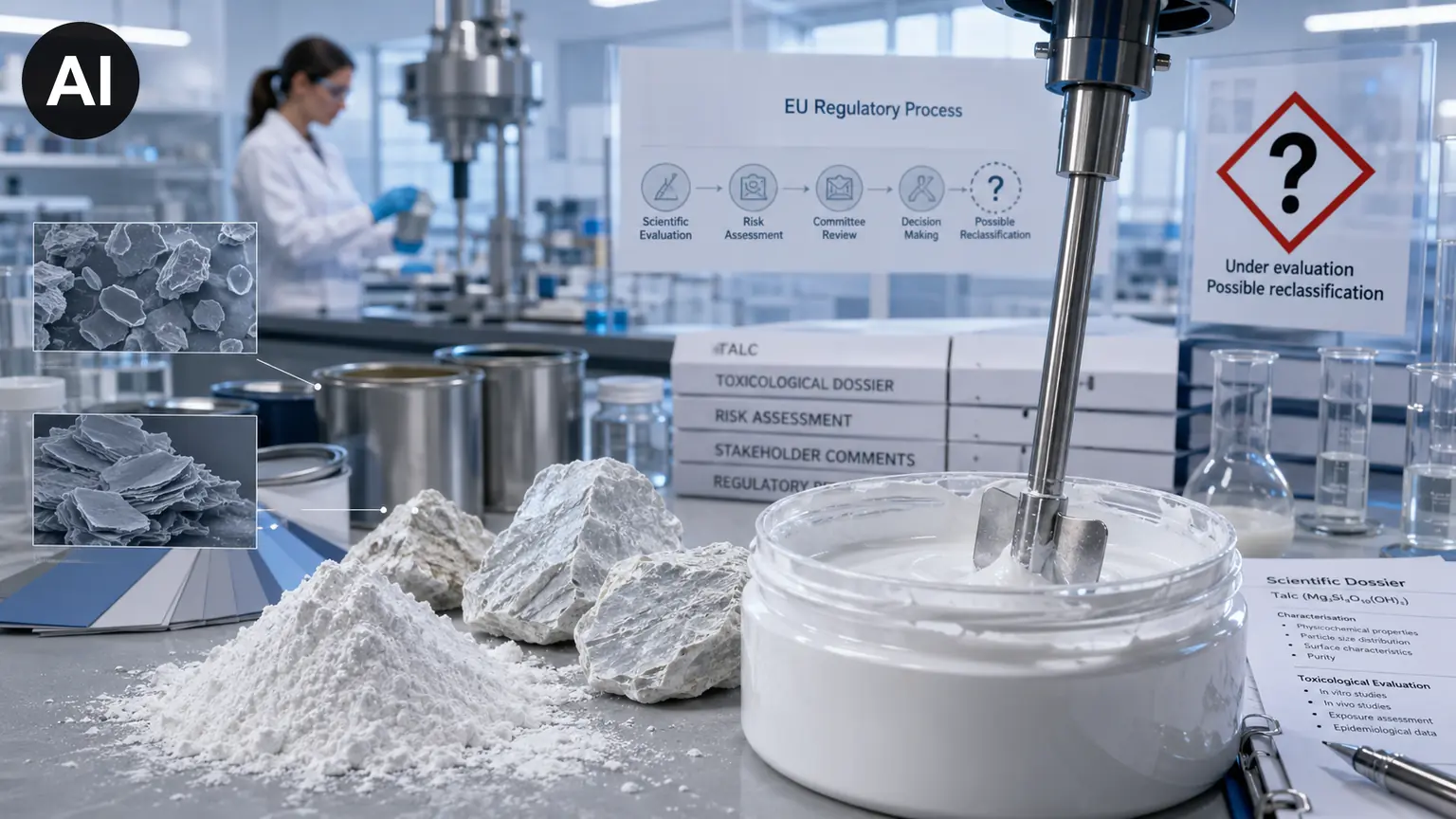
Talc is the most inconspicuous raw material on the shelf. A soft magnesium silicate, at home for decades in coatings, plastics, paper and cosmetics. And it is precisely this raw material that now faces one of the most far-reaching reassessments European chemicals regulation has triggered in recent years.
For formulators, however, the key message is not “talc causes cancer”. It is: the scientific stage of the procedure is complete, the legal one is not. Between those two sentences lies all the room for manoeuvre manufacturers still have.
What has been recommended – and what does not yet follow from it
The Netherlands initiated a procedure for harmonised classification and labelling (CLH) for talc. The original proposal included Carc. 2 (H351), i.e. suspected of causing cancer.
ECHA’s Committee for Risk Assessment (RAC) went considerably further. Its opinion recommends:
| RAC recommendation | Meaning |
|---|---|
| Carc. 1B – H350 | “May cause cancer” – presumed human carcinogen |
| STOT RE 1 – H372 | Damage to the lungs through prolonged or repeated inhalation exposure |
That is a recommendation, not applicable law. A harmonised classification only becomes binding for companies once the European Commission adopts it and the entry appears in Annex VI to the CLP Regulation. In ECHA’s registry the dossier sits at “Opinion Adopted” following the adopted RAC opinion: the scientific stage is done, the Commission decision is pending.
So anyone reading today that talc is classified as carcinogenic in the EU is reading ahead. Anyone concluding that nothing is happening is not reading far enough.
The evidence: neither acquittal nor proof
The debate cannot be dismissed as a regulatory error. Independently of the EU procedure, the International Agency for Research on Cancer (IARC) evaluated talc in June 2024 and classified it as probably carcinogenic to humans (Group 2A) – on the basis of limited evidence in humans, sufficient evidence in experimental animals and strong mechanistic evidence. The monograph appeared in Volume 136. Talc containing asbestos is explicitly distinguished from this; it remains in Group 1 via asbestos.
What matters is what “limited” means in this system: a positive association was observed and a causal explanation is plausible – but chance, bias and confounding could not be sufficiently ruled out. “Limited” is neither “proven” nor “nothing”. Both shortcuts can be heard in the current discussion, and both are wrong.
That the data situation remains open is confirmed by the authorities themselves. In 2026 EFSA launched a new call for data on talc as food additive E 553b, asking among other things for additional genotoxicity studies and for data on whether talc particles become systemically available at all after oral intake. This does not refute the RAC recommendation – it shows that the toxicological basis for individual exposure routes is not yet settled.
Industry argues from exactly that point: the talc association and the coatings associations hold that the demonstrable problem concerns respirable dust, not the substance across all exposure routes. That is a technically legitimate question. But it comes from directly affected associations and does not replace an independent assessment.
And one point is regularly skipped in the public debate: classification is about hazard, not risk. A hazard classification says what a substance can do in principle. It does not say how high the exposure of a paint applicator or a formulator actually is at a given concentration, dust release and exposure duration. That remains the job of the risk assessment.
Why 0.1 per cent is the number that really counts
For formulations, the headline is not what matters – a generic concentration limit in the CLP Regulation is.
| Classification of the ingredient | Generic limit for the mixture |
|---|---|
| Carc. 1B | from 0.1 % by weight the mixture itself is classified as Carc. 1B |
| STOT RE 1 | from 10 % Category 1; between 1 % and below 10 % Category 2 |
The difference is enormous. The lung recommendation only bites at high talc contents. The carcinogenicity classification bites at practically any functional use – a filler reaches 0.1 per cent before it does anything at all.
This would no longer be about the bag in the raw material store, but about the finished, liquid product: labelling with the signal word “Danger”, the health hazard pictogram and H350, revised safety data sheets, and tighter occupational safety requirements including substitution assessment.
A second step may follow, but is not automatically decided with it: REACH Annex XVII excludes certain CMR substances of categories 1A and 1B, and mixtures containing them above their concentration limits, from supply to the general public. For consumer products that would be the truly incisive point. It requires a legal act of its own, though – the RAC opinion alone does not create a sales ban for talc-containing paint today.
What it means for the formulation
Talc is not an extender but a multifunctional filler. Depending on the system it simultaneously influences rheology, matting, sandability, surface hardness, barrier properties, mechanical performance and pigment volume concentration – at a price hardly any speciality additive can undercut. It is used widely in coatings, and in individual sealant and adhesive formulations as well.
From this the associations conclude that a direct replacement is practically impossible. However, no publicly verifiable comparative study with formulations, test methods and results is available. The statement is plausible – and for now it remains an industry position.
The technically cleaner distinction is this: between “not interchangeable one to one” and “not replaceable” lies the difference between a development project and a dead end. Anyone swapping talc for a single other filler will fail in most systems. Anyone breaking the functions down individually and rebuilding them through a new filler and additive system will usually get there – with the corresponding effort for reformulation and requalification.
Points to watch
- Build a talc inventory at formulation level: CAS 14807-96-6, supplier, trade name, content, particle size distribution, information on the respirable fraction – product by product, not by product range.
- Check the 0.1 per cent threshold for each formulation: it decides whether a product would itself be classified in a Carc. 1B scenario.
- Separate consumer, professional and industrial: a possible CMR consumer restriction would hit these segments very differently.
- Assess exposure separately from content: powder handling, dosing and extraction are the relevant points – not the bound talc in the cured film.
- Function mapping instead of raw material comparison: first establish what talc actually does in the specific system, then look for alternatives.
- No-regret measures first: reducing respirable dust pays off regardless of how the Commission decides – the lung recommendation stands alongside the cancer question.
- Do not reformulate in panic: while the legal outcome is open, a robust scenario analysis is the better investment than a rushed full substitution.
Conclusion
The real question is not “is talc harmless or dangerous?”. It is: which hazard is established with what scientific certainty via which exposure route – and which measure protects people without replacing gaps in knowledge with blanket assumptions?
For manufacturers, the answer starts as a data question. Anyone who knows today which talc sits in which product at which concentration will decide within weeks once the Commission rules. Anyone who only starts looking then will need quarters.
Sources
- ECHA – Registry of CLH intentions until outcome (status of the procedure)
- IARC Monographs Volume 136 – talc (WHO/IARC)
- EFSA – Call for data for Talc E 553b
- CLP Regulation (EC) No 1272/2008 on EUR-Lex (classification criteria, generic concentration limits)
- REACH Regulation (EC) No 1907/2006 on EUR-Lex (Annex XVII, CMR supply restrictions)