
Part 1 · Façade
Joint sealants for façade elements – connection and movement joints outdoors, with additional classes INT/EXT/CC.
Joint sealants are judged by their characteristics. We test on a manufacturer-neutral basis by the procedures of DIN EN 15651 – the basis for CE marking and the Declaration of Performance. Accreditation of the testing laboratory to DIN EN ISO/IEC 17025 is planned for 2028 – only as an accredited laboratory will we issue accredited test reports. The testing itself we already perform today – and, on request, relieve your own lab.
The standard applies to joint sealants for non-structural applications in buildings and pedestrian walkways and is the harmonized basis for CE marking and the Declaration of Performance (DoP). It is divided into four parts:
Joint sealants for façade elements – connection and movement joints outdoors, with additional classes INT/EXT/CC.
Joint sealants for glazing – sealing in structural glass construction (additional class CC).
Joint sealants for sanitary joints – with increased resistance to micro-organisms (XS).
Joint sealants for walkable and trafficable surfaces – mechanically highly stressed (INT/EXT/CC).
A sealant is classified by its movement capability and its behaviour under standardized conditions. Only these classes make products comparable – and market-ready.
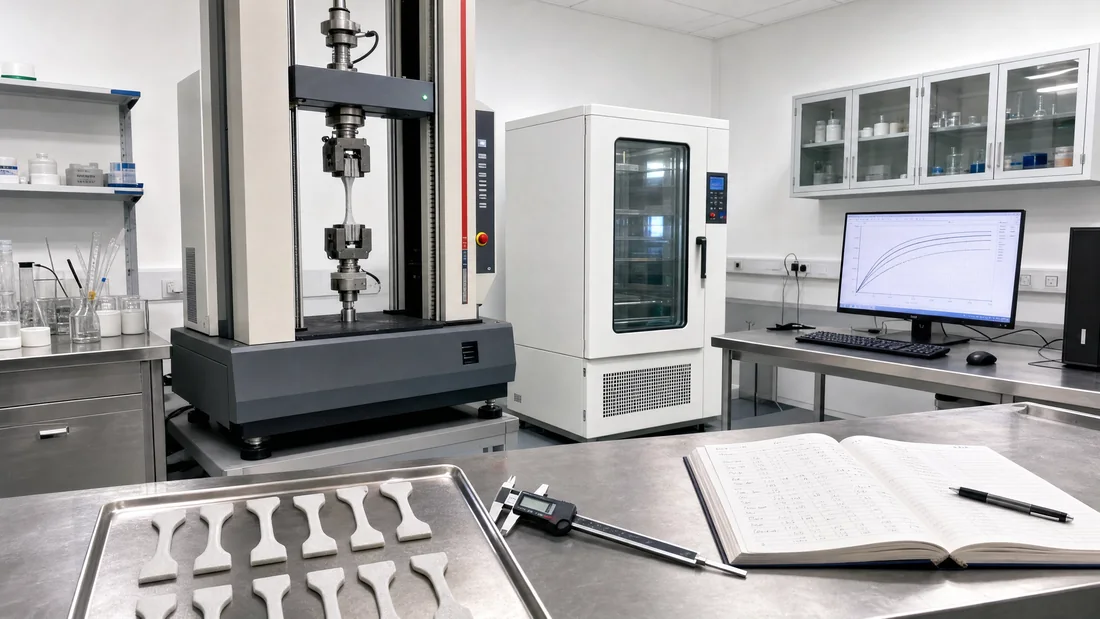
With a tensile testing machine, climate chamber and standardized specimens we map the decisive properties traceably.
Tensile properties, movement capability and behaviour under elongation.
Adhesion and compatibility testing on relevant substrates.
Temperature, humidity and weathering by standardized procedures.
Elastic recovery and volume loss after loading.
For sanitary applications to DIN EN 15651-3.
Reliable test reports as the basis for CE and Declaration of Performance.
Full order books, but your own lab is at capacity? Hand individual test steps – or the complete test series – over to us. We work to standard and return reliable results. That way you expand your capacity without keeping testing equipment in-house, and gain time for what only you can do.
Discuss outsourcingWe are building the testing laboratory with a clear goal: accreditation to DIN EN ISO/IEC 17025 – the standard for the competence of testing laboratories. Only as an accredited laboratory may we document testing to DIN EN 15651 with accredited test reports.
Lab, testing equipment and procedures are being set up.
Method validation and inter-laboratory tests for assurance.
The testing laboratory is accredited to DIN EN ISO/IEC 17025 – the standard for the competence of testing laboratories.
Accredited test reports (DIN EN 15651) – the basis for CE & Declaration of Performance.
The testing itself we already perform today – by the procedures of DIN EN 15651. What is not yet possible before the accreditation of the testing laboratory (DIN EN ISO/IEC 17025 – competence of testing laboratories, planned from 2028) are accredited test reports for CE marking and the Declaration of Performance. We issue those as soon as the laboratory is accredited.
Yes. As an independent body we test on a manufacturer-neutral basis – with no interest of our own in the result.
Material, details of the intended use (parts 1–4) and the substrates. We agree the exact test scope with you in advance.
Yes. From producing the H-test specimens through curing and various storage regimes to testing to standard, we take on individual steps or the complete test series – ideal when your own lab capacity is tight or you want to free up time for other work.
Tell us what needs testing – we'll clarify scope, schedule and options transparently with you.