

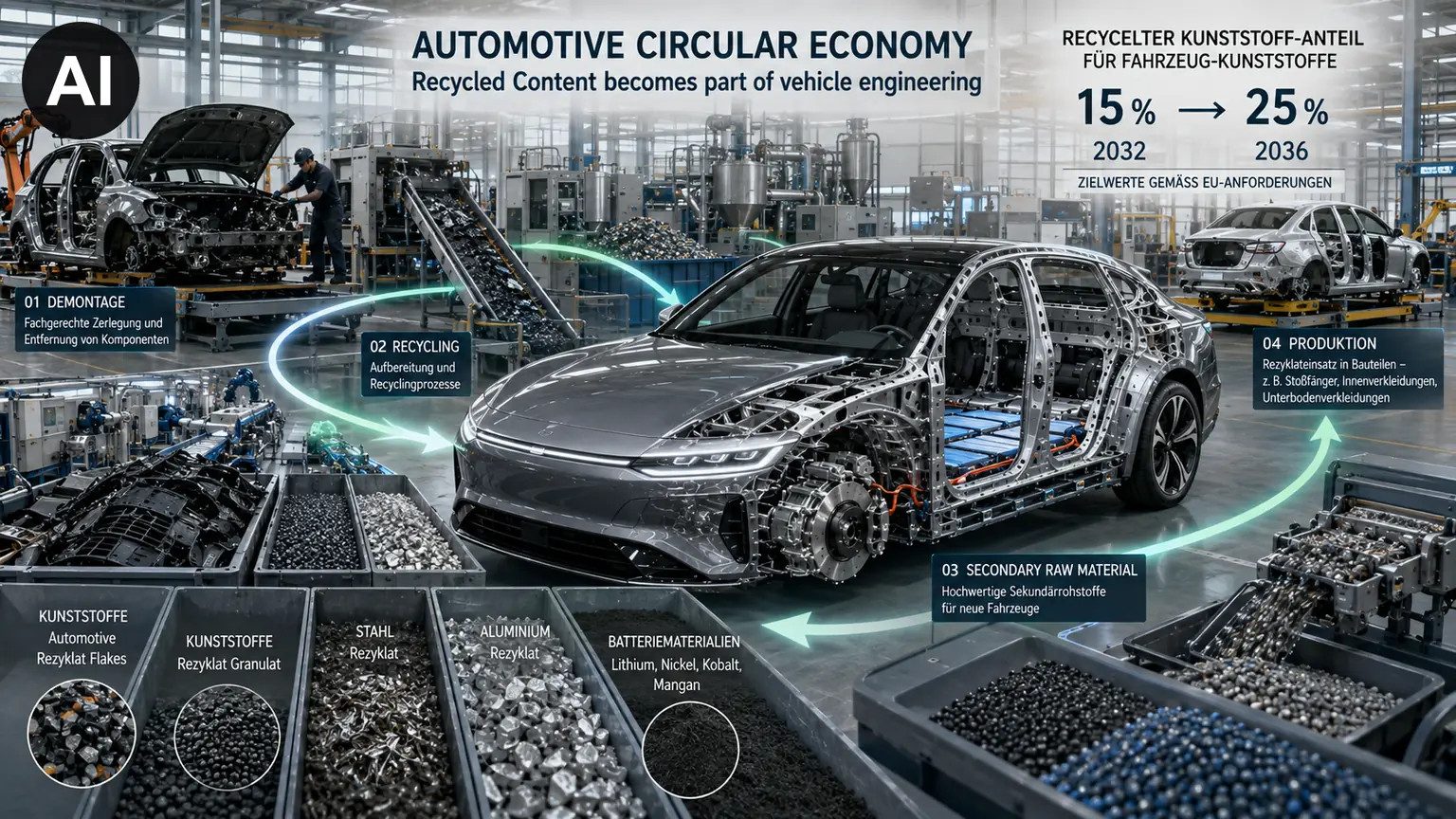
Published on 24 July 2026, in force since 13 August 2026: with Regulation (EU) 2026/1738 on circularity requirements for vehicle design and on the management of end-of-life vehicles, the EU has for the first time adopted binding recycled-content shares directly for new vehicles. It applies in large parts from 1 September 2028.
Anyone still thinking “25 per cent from 2030” needs to recalibrate. That figure comes from the Commission proposal of 2023 – it is not in the final regulation.
What actually applies
The plastics quota was stretched during the negotiations and split into two stages:
| Stage | Post-consumer plastic | of which from vehicle loops | in practice |
|---|---|---|---|
| from 1 September 2032 | 15 % | at least 20 % of the target | 3 percentage points |
| from 1 September 2036 | 25 % | at least 20 % of the target | 5 percentage points |
Two misunderstandings are worth avoiding.
First: the 20 per cent is not a second share of the plastic weight but a share of the respective target quota. From 2032, therefore, at least 3 percentage points – not 20 – must come from end-of-life vehicles or from parts removed during the use phase.
Second: the quota does not refer to vehicle mass but to the plastics covered in the vehicle. Tyre elastomers and most thermosets are excluded; polyurethane cushioning foams are an explicit exception.
Equally important: recycling rate and recycled content are two different metrics. The familiar 85 and 95 per cent describe what is recovered from the vehicle at end of life. The 15 and 25 per cent describe what goes in at the beginning. In future both apply side by side.
What actually happens in 2030: from 14 August 2030, plastics recycled in third countries may also be counted – but only if the facility meets the conditions of Annex XIII, including the audit requirements. 2030 is therefore not a quota year but a verification year.
The timeline that really counts
The decisive phase is not 2030 but 2028 to 2036:
- 2028 – By 31 August the harmonised calculation and verification method for recycled plastics must be in place; from 1 September the regulation applies generally. By 30 September the minimum shares for steel and aluminium are to be set.
- 2029 – From 1 September: a company-wide circularity strategy and harmonised extended producer responsibility (EPR), whose fees are modulated by recyclability, dismantling effort and recycled content used, among other criteria.
- 2030 – Third-country recyclates only under EU-compliant conditions and with audits.
- 2031 – Scope extended beyond passenger cars and light commercial vehicles. In parallel the recycled-content shares of the EU Battery Regulation apply: from 18 August 2031, 16 % cobalt, 85 % lead, 6 % lithium, 6 % nickel.
- 2032 – 15 % post-consumer plastic, digital circularity passport, design-for-disassembly obligations.
- 2033 – From 14 August at the latest the recycled-content shares for steel and aluminium apply.
- 2036 – 25 % plastic; the battery shares rise to 26 % cobalt, 12 % lithium, 15 % nickel.
The battery requirements are not part of the plastics quota but a separate material regime under Regulation (EU) 2023/1542.
Why this concerns the chemistry in the vehicle
Coatings, sealants and adhesives rarely sit in the numerator of this quota. But they largely determine whether the denominator comes back at all – and in what quality.
Joining technology versus dismantlability. The familiar design requirement stays: at least 85 per cent by mass reusable or recyclable, at least 95 per cent by mass reusable or recoverable. What is new arrives in 2032 – certain parts must be easier to remove, traction batteries and electric motors easily and, as far as possible, without destruction. An adhesive saves weight, increases stiffness and replaces weld spots – and at the same time makes clean separation harder. This conflict of objectives therefore moves out of waste management and into the early development phase.
Coatings as contaminants in the recyclate stream. Paints, primers, laminations, barrier layers, labels and printing inks end up in the material stream together with the carrier polymer when a vehicle is shredded. They affect colour, odour, emissions and the mechanical properties of the recyclate – and thereby help decide whether a component becomes automotive quality again or only an application with lower requirements.
Recyclate behaves differently from virgin material. Additive history, residual moisture, contamination, surface energy and batch-to-batch variation scatter more widely in post-consumer material. Adhesion on a PCR polypropylene is not adhesion on virgin material. Pre-treatment, primer selection and process windows therefore belong on the test bench early – not at series release.
Metals: for steel, the permissible total copper content of the main steel fraction is lowered to a maximum of 0.15 per cent by weight from September 2031. Aluminium must be separated into at least cast and wrought alloys from 2029, and more finely into at least four fractions from 2032. The intention is unambiguous: no downcycling of high-grade body materials.
The real bottleneck is the material, not the technology
Plenty can be recycled. The question is whether enough high-grade, documented post-consumer material in automotive quality will be available.
Germany shows the problem in a single comparison: in 2023 authorised treatment facilities took in around 253,000 end-of-life vehicles – while roughly 2.3 million vehicles were exported as used cars. Material recycling reached 86.1 per cent, total recovery came in just below the 95 per cent target. For a genuine car-to-car loop, the car is what is missing first.
The legislator expects the bottleneck too: if certain recycled plastics are not sufficiently available or their prices rise excessively, the Commission can grant temporary exemptions from the quota or the timetable. A safeguard clause, however, is not a planning basis.
The calculation rule itself is also still open. For recyclates from processes other than mechanical recycling, the regulation prescribes a mass balance methodology. How process losses, mixed feedstocks and co-products are allocated determines which volumes are ultimately eligible – and has to be settled by 31 August 2028.
Points to watch
- Do not plan around “25 % from 2030”: what is binding is 15 % from September 2032 and 25 % from September 2036.
- Clarify the denominator: which plastics in the component count towards the reference base at all – and which are excluded?
- Calculate the closed loop correctly: 20 per cent of the target quota equals 3 or 5 percentage points, not 20.
- Qualify adhesion and coatability on PCR grades: with real recyclate batches and their scatter, not with a sample delivery.
- Manage dismantlability as a development parameter: alongside cost, weight, crash and NVH, dismantling time, material separability and recyclate compatibility belong in the specification.
- Secure supply contracts and proof of origin early: third-country audits arrive in 2030, the digital circularity passport in 2032 – recycled content becomes a compliance data question.
- Do not wait on steel and aluminium: the percentages come in 2028 and apply by 2033 at the latest – sorting quality is tightened before that.
- Treat batteries separately: cobalt, lead, lithium and nickel follow their own regime with their own deadlines.
Conclusion
The real turning point is not a year. It is the shift from waste-oriented vehicle regulation to a closed material regime that links design, material selection, joining technology, type approval, producer responsibility and digital traceability.
That is decided between 2028 and 2033 – when calculation methods, supply contracts, recycling capacity and data architectures are set. Whether 15 per cent in 2032 is a routine requirement or an expensive procurement bottleneck will not be decided in 2032.